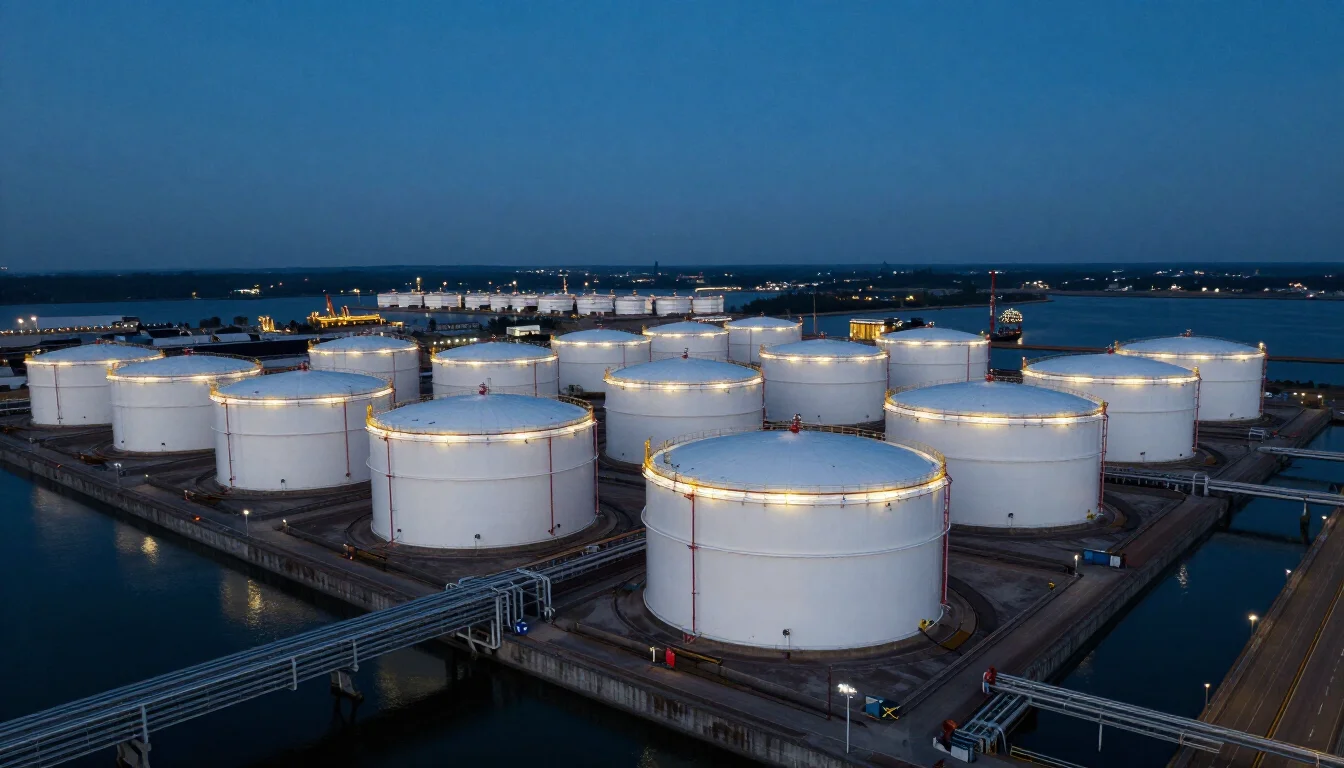
Tank terminals
Tank terminal capability at seven partner ports
Through partnerships at Houston, Rotterdam, Jurong, Fujairah, Ningbo-Zhoushan, Qingdao and Busan, PLATINUM ENERGY STORAGE coordinates tank terminal operations, bulk storage and product terminalling for liquid energy products — matching each customer to the port that fits their trading route.
Tank terminal capability
What a tank terminal does, broken down
Operations, bulk storage, product handling, loading and unloading, and marine and pipeline connectivity — each runs inside one operating environment. Open any of them below for the detail.
Terminal Operations
A 24/7 control room orchestrates every receipt, storage and dispatch movement under SCADA supervision, with automated custody transfer and disciplined shift handovers.
Learn moreBulk Tank Storage
Secure tank storage for liquid energy products at strategic energy ports — compatibility-based allocation, real-time monitoring and environmental protection throughout.
Learn moreProduct Handling
Controlled receipt, transfer, storage, movement and dispatch through dedicated manifolds — preserving product quality and preventing cross-contamination.
Learn moreLoading & Unloading
Scheduled truck, rail and marine loading and unloading with product verification, safe connections, vapor recovery and efficient turnaround.
Learn moreMarine & Pipeline Connectivity
Marine berths and pipeline interconnects linking storage to ships, refineries and distribution networks under measured, documented procedures.
Learn moreProducts stored & terminalled
Liquid energy products we store and terminall
Our product scope spans crude oil, refined petroleum products, diesel, gasoline and jet fuel — each handled with compatibility-based tank allocation, laboratory-verified quality and custody-transfer measurement on every movement. Product acceptance is always subject to compatibility, facility capability and partner arrangements at the relevant location.
Crude Oil
Secure storage and terminalling for crude oil and condensate — compatibility-based tank allocation, heating where required, custody-transfer measurement and environmental protection.
- Crude & condensate across grades
- Heating control for viscous crudes
- Secondary containment & overfill protection
Refined Petroleum Products
Storage and terminalling for gasoline, diesel, jet fuel, fuel oil and related streams — with segregation, blending support and laboratory-verified quality.
- Full refined product range
- In-line blending & additivation
- Lab-verified quality release
Diesel
Secure storage, handling and dispatch of diesel and distillate fuels — quality verification, batch control and efficient truck, rail and pipeline loading.
- Diesel & distillate grades
- Batch-controlled loading
- Multimodal dispatch
Gasoline
Secure storage, blending and dispatch of gasoline and blend components — vapor recovery, segregation and laboratory-verified finished grades.
- Finished gasoline & blendstock
- Vapor recovery on volatile handling
- Blend verification before release
Jet Fuel
Secure storage and handling of jet fuel and aviation kerosene — strict quality control, segregation, laboratory verification and aviation-grade documentation.
- Aviation kerosene grades
- Strict dedicated segregation
- Traceable quality records
Your product
Need to store or terminall a specific product? Share your product, volume and preferred location and our team will confirm compatibility and availability.
Quality & custody
Specification preserved, figures that reconcile
Every product family has its own storage, compatibility, measurement and handling requirements. We manage those requirements with discipline and transparency — so product is held securely, preserved to specification and returned in the condition and quantity agreed.
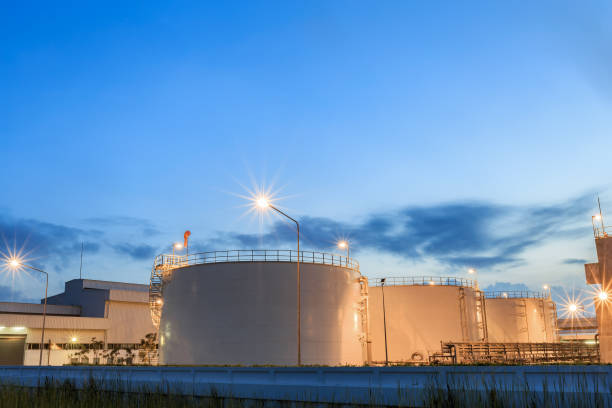
Tanks are allocated by product compatibility, with segregation and cleaning procedures wherever shared infrastructure is used. On-site laboratory analysis verifies quality on receipt, during storage and before dispatch — so each product retains its specification from arrival to release.
Every receipt and dispatch is supported by sampling, gauging and custody-transfer metering, with mass-based stock accounting and reconciliation — so the figures that support a commercial transaction can be traced to a verified, auditable source.
Lab Verification
On-site analysis against specification.
Quality Release
Gated release on every dispatch.
Segregation
Cross-contamination prevented.
Custody Metering
Reconciled, auditable figures.
Strategic port partnerships
Storage access at seven major energy ports
Our partnership network connects customers with tank storage at seven major energy ports — each chosen for its market access, shipping connections and product capabilities.
Houston
Storage access supporting gulf coast energy market.
Rotterdam
Storage access supporting european energy & maritime hub.
Jurong
Storage access supporting singapore energy & maritime environment.
Fujairah
Storage access supporting regional & international energy trading.
Ningbo-Zhoushan
Storage access supporting asian trading, storage & maritime logistics.
Qingdao
Storage access supporting chinese maritime & industrial market.
Busan
Storage access supporting northeast asia energy logistics.
Each port in the network offers different market access, shipping connections and product capabilities; we match customers to the facility that fits their route. Tank count, capacity, product compatibility and service availability differ by facility and are confirmed with each customer before any commitment.
13612 Midway Rd, STE 200, Farmers Branch, TX 75244-3404, USA
Marine & pipeline connectivity
Connecting ships, pipelines and storage
Marine berths and pipeline interconnects link our terminals to the ships, refineries, distribution networks and adjacent facilities that move product in and out — under controlled, measured procedures.

Marine movements follow a disciplined sequence — scheduling, mooring, safe connection, transfer under continuous monitoring, measurement, documentation and departure — governed by recognised safety guidance and port-authority requirements.
Pipeline interconnects support receipt from and dispatch to refineries, distribution networks and adjacent terminals, with continuous flow monitoring and custody-transfer metering on every transfer.
More on marine & pipeline connectivityTransition-ready
Preparing for lower-carbon fuels
As biofuels, renewable feedstocks and future hydrogen carriers enter the product mix, our controls, procedures and partnerships adapt to their specific properties — so lower-carbon fuels are handled with the same operational discipline as conventional products.